


Thermal barrier coating
Definition
Thermal Barrier Coating is a ceramic coating that is deposited on the surface of a high temperature resistant metal or super alloy, which acts as a thermal insulation for the base material to lower the temperature of substrate. Then the engine or turbine blades with thermal barrier coating can run at high temperatures. And the thermal barrier coating can also improve the device (engine, etc.) thermal efficiency of 60% or more. See the picture as below:
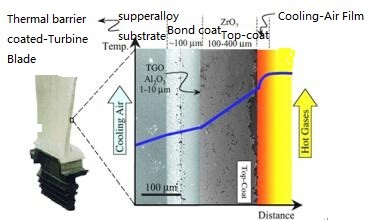
Normally we use the ZrO2 as Top ceramic coating and Al2O3 powder and NiMoAl (NiAl95/5 instead) wire as bond coating to make the thermal barrier coating. With the application of thermal barrier coating on hot end parts of high temperature engine, it is recognized that the application of thermal barrier coating not only improve the anti-high temperature corrosion resistance of the matrix, but also reduce the fuel consumption and improve the fuel efficiency, thus it can also extend the service life of hot parts. So compared with the development of new high-temperature alloy materials, thermal barrier coating research costs is lower and the process is also feasible.
Application
With the development of aviation, aerospace and civil technology, the use of hot parts of the increasingly high temperature requirements, has reached the limit of high temperature alloys and single crystal materials. For example, they are in the harsh environment of high temperature oxidation and high temperature airflow erosion, such as nozzles, blades and combustion chambers. The temperature will be more than 1100 degree, which exceeds the limit temperature (1075 degree) of high temperature nickel alloy. The thermal barrier coating prepared by combining the high strength and high toughness of the metal with the high temperature resistance of the ceramic can solve the problem. It can play the role of heat insulation, anti-oxidation and anti-corrosion. It has been used in steam turbine, diesel Generators, jet engines and other hot-end materials to obtain a certain application, and extend the service life of hot-end components.
Preparation Methods
1. Plasma spraying method
2. HVOF flame spraying method
3. Laser cladding method


