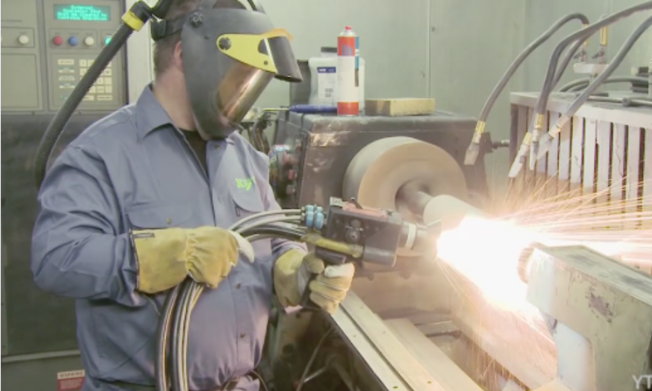
Arc Spray Process
Arc Spray uses an electric arc between two consumable wires of the surfacing materials as the heat source, a pair of electrically conductive wires are melted by electric arc. And compressed gas atomizes and propels the molten material to the workpiece. The impacting molten particles on the substrate rapidly solidify to form a coating. This arc spray process carried out correctly is called a "cold process" (relative to the substrate material being coated) as the workpiece temperature can be kept low during processing to avoid damage, metallurgical changes and distortion to the substrate material.
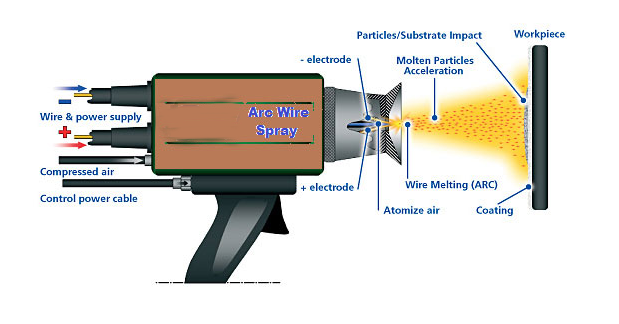
Schematic Diagram of the Electric Arc Wire Thermal Spray Process
The wire feeder is similar as gas metal arc welding except that it feeds for gas met two wires. The gun can be hand held or mounted in a holding and movement mechanism. The part or the gun is moved with respect to the other to provide a coating surface on the part.
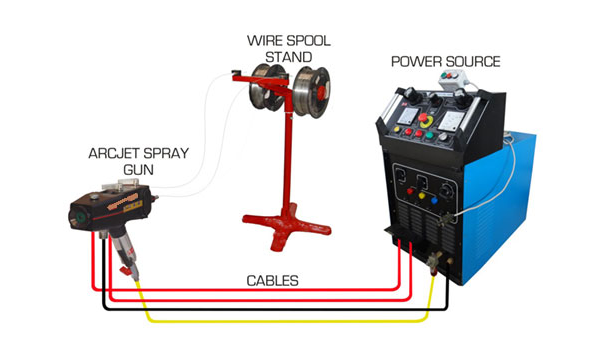
Electric arc spray coatings are normally denser and stronger than other equivalent combustion spray coatings. Low running costs, high spray rates and efficiency make it a good tool for spraying large areas and high production rates.
Disadvantages of the electric arc spray process are that only electrically conductive wires can be sprayed and a separate heating source is needed if substrate preheating is required.
The main applications of the arc spray process are anti-corrosion coatings of zinc and aluminum that work on large components. But almost all metals, which can be drawn into wire can be sprayed. Following are metals, which commonly arc sprayed: Nickel-Aluminium, Babbitt, Brass, Bronze, Copper, Molybdenum, Monel, Inconel, Nickel, Stainless steel, Carbon steel, and Tin.