


Cobalt base Investment Casting Components
Wisdom has two primary techniques for manufacturing cobalt base components: casting and powder metallurgy. Powder metallurgy is suitable for small and regular dimension while casting can apply to wider situations. There are generally four kinds of casting processes: investment, sand, resin shell and centrifugal. Investment casting is what we mostly use.
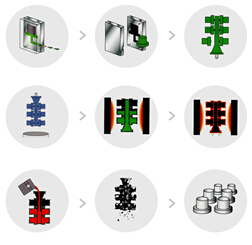
Investment casting process uses wax patterns assembled in tree forms on a runner. The completed assembly is coated with ceramic slurries, allowed to dry and then heated to melt out the wax leaving ceramic molds into which the molten alloy is poured. It can be understood from the graph on the right hand side:
One advantage of investment casting components is the high precision that can reduce certain machining operations. As a result, this process applies to producing parts with extremely high demands on near-shape and surface quality. Another merit is that it can multiply large quantities of parts with the same shape in one production.
Because of the replication, it may cause exterior and interior defects in investment casting components. The most common ones emerging are surface crack and interior porosity. In terms of surface inspection, Wisdom’s typical castings parts, i.e. Co-6 bars, sheets and Co-20 balls, can be examined from following parameters:
- Bar: tolerance, ovality, bend
- Sheet: tolerance, roughness, parallelism and straightness
- Ball: tolerance, sphericity, roughness
In order to prevent from interior flaws, a high quality investment casting needs sectioning testing or NDT (non-destructive testing). Six most frequently used NDT inspection methods are:
- Visual Testing VT
- Radiographic Testing RT
- Ultrasonic Testing UT
- Magnetic particle Testing MT
- Penetrant Testing PT
- Eddy Current Testing ET


