


Solutions for Valve Seats on Oil Well Tree from Wisdom
There are three general functions of an oil well tree:
- On producing wells, it can inject chemicals or alcohols or oil distillates to prevent and or solve production problems like blockages.
- It can control the injection of gas or water on a producing or non-producing well to balance the production volumes of gas considering other wells in the field.
- The control system attached to the tree controls the downhole safety valve (for example, surface controlled subsurface safety valves, downhole safety valve or subsurface safety valve) while the tree acts a connector for the control system to the downhole safety valve.
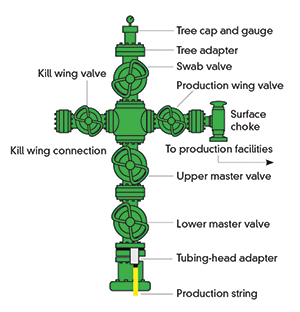
Below are parts definitions:
1. The two lower valves are called the master valves (upper and lower, respectively) because they lie in the flow path, which well fluids must take to get to the surface. The lower master valve will normally be manually operated, while the upper master valve is often hydraulically actuated. Hydraulic tree wing valves are usually built to be fail-safe closed, meaning they require active hydraulic pressure to stay open.
2. The right-hand valve is often called the flow wing valve or production wing valve, because it is in the flow path the hydrocarbons take to production facilities.
3. The left-hand valve is often called the kill wing valve. It is mainly used for injection of fluids such as corrosion inhibitors or methanol to prevent hydrate formation.
4. The valve at the top is called the swab valve and lies in the path used for well interventions like wireline and coiled tubing.
5. The choke is the device, either stationary or adjustable, used to control the gas flow, or create back pressure.
As the key parts of an oil well tree, each one of the five valves has a core parts: valve seat. Corrosion and wear resistant properties are required on the surface. Wisdom, as a surface technology company, offer Stellite and tungsten carbide hardfacing materials for welding (PTA, Laser) and thermal spraying (HVOF). Besides, we also offer integrated solution for the machined valve seats by casting or hardfacing on substrates. The related alloys are Stellite 6, WC-12Co, WC-10Co-4Cr, WC-17Co, and WC-10Ni.


