


High Velocity Oxygen Fuel Thermal Spray Process
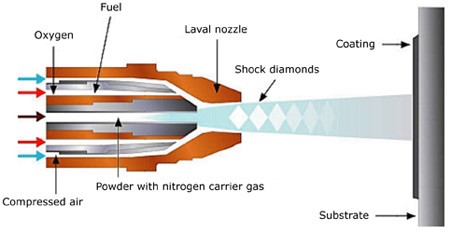
High Velocity Oxygen Fuel Thermal Spray Process(HVOF) is basically same as the combustion powder spray process (LVOF) except that this process has been developed to produce extremely high spray velocity.
There are many HVOF guns that use different methods to achieve high velocity.
One method is basically a high pressure water cooled HVOF combustion chamber and a long nozzle. Fuel (kerosene, acetylene, propylene and hydrogen) and oxygen are fed into the chamber, and combustion produces a hot high pressure flame which is forced down a nozzle to increasing the velocity. Powder is fed axially into the HVOF combustion chamber under high pressure.
Another method is a simpler system of a high pressure combustion nozzle and air cap. Fuel gas (propane, propylene or hydrogen) and oxygen are supplied at high pressure and combustion occurs outside the nozzle but within an air cap supplied with compressed air. The compressed air pinches and accelerates the flame and acts as a coolant for the HVOF gun. Powder is fed at high pressure axially from the center of the nozzle. But in the air cap that supplies compressed air. The compressed air clamps and accelerates the flame and acts as a coolant for the HVOF gun. Powder is fed at high pressure axially from the center of the nozzle.
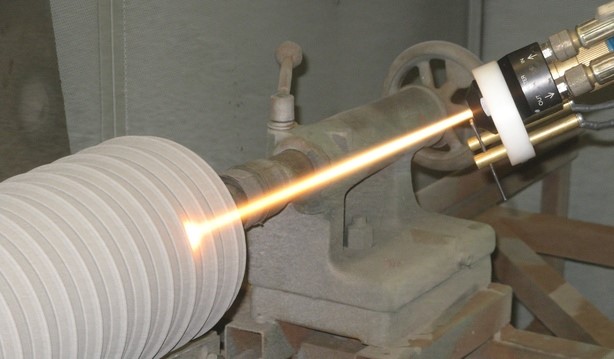
The coating produced by HVOF is similar to the coating produced by the explosion process. HVOF coatings are very dense, strong and low residual tensile stress and compressive stress in some situations, which can make much thicker coatings compared with other coating processes.
Except excellent bonding strength, HVOF coatings can be sprayed thicker coatings due to the extremely high velocity to form compressed coatings instead of tensional coatings. This enables materials such as carbide to be sprayed more than 6mm very quickly.
Typical coating materials:
Nickel & Cobalt based alloy powders, such as Stellite alloy powders.
Inconel alloy powders,
Iron based alloy powders, such as 304L, 316L.
Carbides & Ceramics.
Main applications:
High Temperature applications
Wear resistance, Abrasive, Erosion, etc.


