


About Cold Spray
Cold spray technology (CS: Cold Spray), also called gas-powered spray technology. It is a method, which has plasticity high-speed solid particles to impact the matrix and make a strong plastic deformation and deposition to become the coating.
Generally cold spray technology is different from traditional thermal spraying (such as High-speed flame spray, plasma spray and explosion spray). It doesn’t need to melt metal particles during spraying. Cold spray uses compressed air to accelerate metal particles to critical velocity, through the nozzle, the metal particles are physically deformed after hitting the surface of the matrix. The metal particles collide with the surface of the matrix and attached firmly. The metal particles are not melted during the entire process. The temperature generated on the surface of the sprayed maxtrix does not exceed 150 degrees. The principle of cold spraying is shown below:
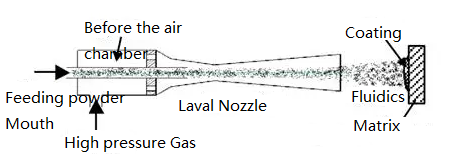
In the cold spray process, after the high-velocity particles hitting the matrix, the formation may be coating or shot blasting or erosion of the matrix or the perforation effect on the maxtix, which depending on the velocity of the particles before they hit the matrix. All material has a critical velocity (Vc). When the particle velocity is higher than Vc, the particles will be deposited on the matrix surface after collision, and when the particle velocity is less than Vc, erosion will occur (the matrix surface is damaged, the metal particles are dropped). Vc varies depending on the type of powder and is generally about 500 to 700 m/s. See Table 1 for details. Therefore, in order to increase the velocity of the gas flow and thus increase the velocity of the particles, cold spray technology can also preheat the accelerated gas into the spray gun, usually with a pre-heating temperature of less than 600 degrees; At the same time, in order to obtain high particle velocity and deposition efficiency, We require the particle size and distribution is small, usually range is 1-50 micron.
Critical of Velocity of different metal particles.(m/s)
|
Materials |
Cu |
Ni |
Fe |
Al |
|
Critical Velocity |
560-580 |
620-640 |
620-640 |
680-700 |
Cold spray technology is divided into high pressure cold spray and low pressure cold spray. And the high pressure cold spraying uses 15 atmospheres (psi) or more, and the low pressure cold spraying uses 10 atmospheres (psi). Compared to traditional thermal spray technology, high pressure and low pressure cold spray technology have the following common advantages:
1) It can be used to spray many types of materials with certain plasticity to obtain conductive, heat-conducting, anti-corrosive and wear-resistant coatings, such as pure zinc, aluminum, copper, iron, nickel, titanium, stainless steel, bronze and other alloys. It is also possible to prepare nickel based super alloys.
2) Cold spraying particles are low-temperature and high-speed, which can avoid physical and chemical reactions of particles during acceleration and heating. They are suitable for temperature-sensitive (nano, amorphous, etc.), sensitive to oxidation (Cu, Ti, etc.) and sensitive to phase transition (metal ceramic) coating materials.
3) The thermal effect on the substrate is small. The instantaneous temperature of the surface of the matrix to be sprayed can’t exceed 150 degrees, and the body temperature is 70 degrees (the specific temperature is related to the speed of the sprayed particles and the spray gun movement), which can prevent the matrix from thermal deformation and material structure damage.
4) Cold spray can be sprayed on any metal, glass, ceramic and rock surface.
5) The coating is compact and thick, which can reach 10mm or even more. Because high-velocity particles are deposited on the substrate with plastic deformation, the coating structure is dense, and a large compressed stress is generated in the coating, then a thick coating can be prepared.
6) Metal particles can be recycled. Because the metal particles without rich thermal process experiences. And without the structural changed, we can recycle the drop metal particles.


